
A message for World Ocean Day (8 June) — by Shweta Khare Naik
I didn’t grow up near the ocean. But the moment I was properly in it, not standing at the edge, not wading, but actually in it, something shifted. Not dramatically. More like a recognition. Like remembering something I hadn’t known I’d forgotten. That’s the thing about the ocean. It doesn’t feel like an introduction. It feels like a reunion. And I’ve been trying to understand why ever since.
For most children, the ocean first arrives as a place attached to memory. A family holiday. Wet slippers in a hotel corridor. Sand stubbornly stuck to the backseat of the car. A horizon that feels endless in a way children notice instinctively. They arrive with buckets and leave with sand in their shoes and salt on their skin, carrying the ocean back with them without knowing it. Without realising that, in a sense, they never left it.
Because the ocean is not somewhere we visit. It is something we are already woven into, something that has been part of us long before any of us first stood at the edge of the sea. And one of the quietest, most important things we can do, for children, for the communities they will grow into, for the future of life on this planet, is help them remember that.
What the ocean actually is
We tend to think of the ocean as a very large body of water located at the edge of land. This is technically accurate and almost entirely misleading. The ocean covers more than seventy per cent of the Earth’s surface. It holds ninety-seven per cent of its water. It produces roughly half the oxygen in every breath we take, not from forests, as most people assume, but from billions of microscopic phytoplankton drifting through sunlit surface waters, photosynthesising quietly, making the atmosphere breathable, sustaining every land-based life form on Earth. They have been doing this without acknowledgement, without interruption, for billions of years.
The ocean regulates climate. It absorbs heat, shapes weather, and drives rainfall in ways that reach far inland, into places that have never seen a coastline. The monsoon that farmers across South Asia have oriented their entire lives around, their planting seasons, their festivals, their prayers, the particular grief of years when the rains don’t come, is a function of ocean temperature and ocean circulation.
The rain that falls on mountain ranges and fills rivers moving through cities and villages and fields before returning eventually to the sea began as ocean water lifted by sunlight. Water that has been in the ocean is the water we drink. Water that has been cloud, glacier, and river eventually finds its way back to the ocean. There is no real separation in this system, only movement and return.
And it is more intimate than that. Human blood carries salts and minerals that remind us, in a quieter biological way, that life itself emerged in relation to ancient seas. When a child holds a cup of water, they are holding something that has been ocean many times across geological time, something that will be ocean again.
What we have forgotten
For most of human history, people didn’t need to be taught their relationship with water. They lived it, the way you live with family, without thinking much about it. Fishing communities on coastlines across the world knew the sea’s moods the way they knew the moods of the people they loved, its colours and sounds, its seasonal shifts, the particular quality of its generosity and its danger. Farmers understood that the fertility of their soil was connected to river systems that flowed eventually to the sea. Poets and philosophers across every culture returned again and again to water as a source of meaning, not just survival.
Something changed. Slowly at first, then faster. Urbanisation moved people away from direct contact with natural systems. Children began growing up in environments where food came from stores, water came from taps, and the ocean, if it appeared at all, appeared on screens or as a holiday destination. The connection never disappeared completely. But for many people, it became faint, something sitting quietly in the background of life instead of shaping it directly.
And yet children still instinctively reach toward this relationship before the world slowly teaches them to look away from it. They stop to poke at puddles after rain. They fill pockets with shells. They ask questions adults often answer too quickly. The wondering has not left them. What changes is whether the world around them honours that wondering or quietly redirects it toward more measurable things. This matters enormously, and not only for the ocean’s sake.
The ocean does not need us. We need it. And somewhere in that humbling truth is the beginning of reverence. We do not protect what we do not love. And we cannot love what we have never truly met.
A child who is told that coral reefs are bleaching may feel troubled by that information for a day or a week. But a child who has felt the aliveness of the ocean, who has traced a cup of water back to clouds, rivers, and sea, who has sat quietly listening to the sound of waves and noticed what moves in them, carries something different. Something that doesn’t leave easily.
What ocean literacy really means
Ocean literacy cannot really be reduced to another chapter in a textbook or a themed activity squeezed into a school calendar.
It is a restoration of relationship… It is the slow, careful, sometimes joyful work of helping children understand that they are not separate observers of an ecological system in crisis. They are participants in a living system that has always included them, one that includes their food, their weather, their blood, the air moving through their lungs right now.
Across the world, this work carries both particular richness and particular urgency. Richness because the cultural memory of relationship with water is not yet distant in many places. There are grandparents alive who remember rivers differently. There are communities across Asia, Africa, the Pacific, and Latin America whose festivals and diets and entire sense of time are organised around the movement of water through the landscape, traditions where rivers, coastlines, and rain were never incidental but sacred.
But that memory is being interrupted. Rivers are changing. Children growing up in cities are increasingly distant from the natural systems their lives depend on. And the ocean itself is changing in ways that will affect rainfall, food systems, coastal communities, and climate across the entire planet within the lifetime of children sitting in classrooms today.
The response to that urgency is not to frighten children into action. Fear produces paralysis as often as it produces courage, and in young people, it can produce something worse than both, a sense of helplessness so complete that it becomes easier not to feel anything at all about the ecological world. What helps is not panic, but connection. Helping children experience the natural world as something living and close to them. To give children the experience of genuinely belonging to something living and extraordinary, so that caring for it becomes not a duty imposed from outside but an expression of who they already understand themselves to be.
What a child needs to know
A child should have the chance to experience how strange and alive the ocean really is. That a single drop of seawater holds entire living worlds we cannot see. That whales communicate in songs travelling thousands of kilometres through deep ocean channels. That coral reefs covering less than one per cent of the ocean floor shelter more than a quarter of all known marine species.
A child needs to know that the ocean has memory. That its currents and its chemistry carry the record of everything that has ever happened on this planet’s surface, and that it can be read, by those who have learned how, like an extraordinarily detailed history of life on Earth.
A child needs to know that the ocean is generous. That for billions of years it has given oxygen, rain, food, temperature stability, the very conditions that made their existence possible, and that it has done all of this without anyone asking it to.
But more than any fact or statistic, a child needs to feel that the ocean is part of her own life. Not as a fact to memorise but as something genuinely understood, in their blood chemistry, in the water they drink, in the rain that grew the food they ate this morning, in the weather systems that shape the world they were born into. To understand the ocean is not to understand something distant and external. It is to understand something continuous with their own life.
What we are building…
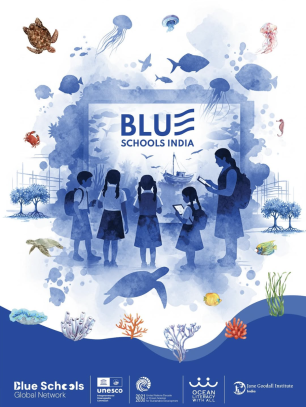
Connect, learn, act, celebrate. That is the Roots & Shoots mantra, and quietly, it is the philosophy underneath everything this work is trying to do. Through Roots & Shoots, Blue Schools India, and the Oceans Are Us campaign, through every educator and young person choosing to bring this kind of thinking into a classroom or a community anywhere in the world, what is being built is not simply an environmental programme. It is something deeper.
A movement rooted in the conviction that when young people feel genuinely linked to the living world, they don’t need to be persuaded to protect it. They already understand why it matters.
What slowly emerges from work like this is not just awareness, but a different way of relating to the world. Children who carry curiosity and wonder with them tend to care differently. Changed by the understanding that their choices, their voices, and their care are part of something much larger than themselves.
At its best, education isn’t just information moving from one person to another. It is also how we learn to relate to ideas, to one another, and to the living world around us. A school that takes ocean literacy seriously understands its students to be ecological beings, embedded in natural systems, worthy of being introduced to the full complexity, beauty, and fragility of the world they have been born into.
That is not a small thing. At a time when ecological disconnection underlies so many of the crises we face, climate inaction, biodiversity loss, and the slow diminishment of everything that makes the natural world what it is, a school that restores relationship is doing something quietly radical. Not as a themed week or an annual day. As a fundamental orientation toward what learning is, and what it is for.
An invitation
This World Ocean Day, no matter where you are, near the sea or far from it, try something small for a moment. Find some water. A cup, a tap running, rain on a window, a river if you’re close enough to one. Look at it a moment longer than you normally would. And trace it back, to the cloud that carried it, to the ocean that lifted it into the sky as vapour, to the currents that moved it across the Earth before it arrived here, in this moment, with you. That water has been the cloud, glacier, river, and sea. It has moved through plants and animals and ancient landscapes whose names we’ve lost. It has participated in climate systems older than human memory…And now it is here. And you are here.
Maybe that’s enough to begin with, the simple, strange, underappreciated fact that you and the ocean are part of the same living system, that you always have been, that belonging to the natural world is not something any of us need to earn or deserve or achieve.
It’s something we only need to remember!
Shweta Khare Naik
Executive Director, Jane Goodall Institute India
Regional Coordinator, Middle East & Indian Ocean Region, Blue Schools Global Network, UNESCO-IOC